Research
AI-driven design, multiphysics modeling, and digital engineering for advanced manufacturing.
We pursue four tightly coupled research thrusts. Each one is useful on its own, but the lab’s distinctive contribution lies at their intersection: design methods that are simultaneously generative, physically grounded, and manufacturable.
Generative AI for Advanced Materials & Component Design
Generative models that propose feasible, manufacturable, performance-driven designs for parts and material microstructures.
생성형 AI를 활용해 기존 설계 방법론으로는 탐색하기 어려운 Nonlinear/Nonconvex 설계 공간을 탐색합니다. 제조 가능성, 성능 목표, 다양한 물리적 제약조건을 함께 반영하여 실제 제작 가능한 고성능 소재 미세구조와 부품 형상 설계안을 제안합니다.
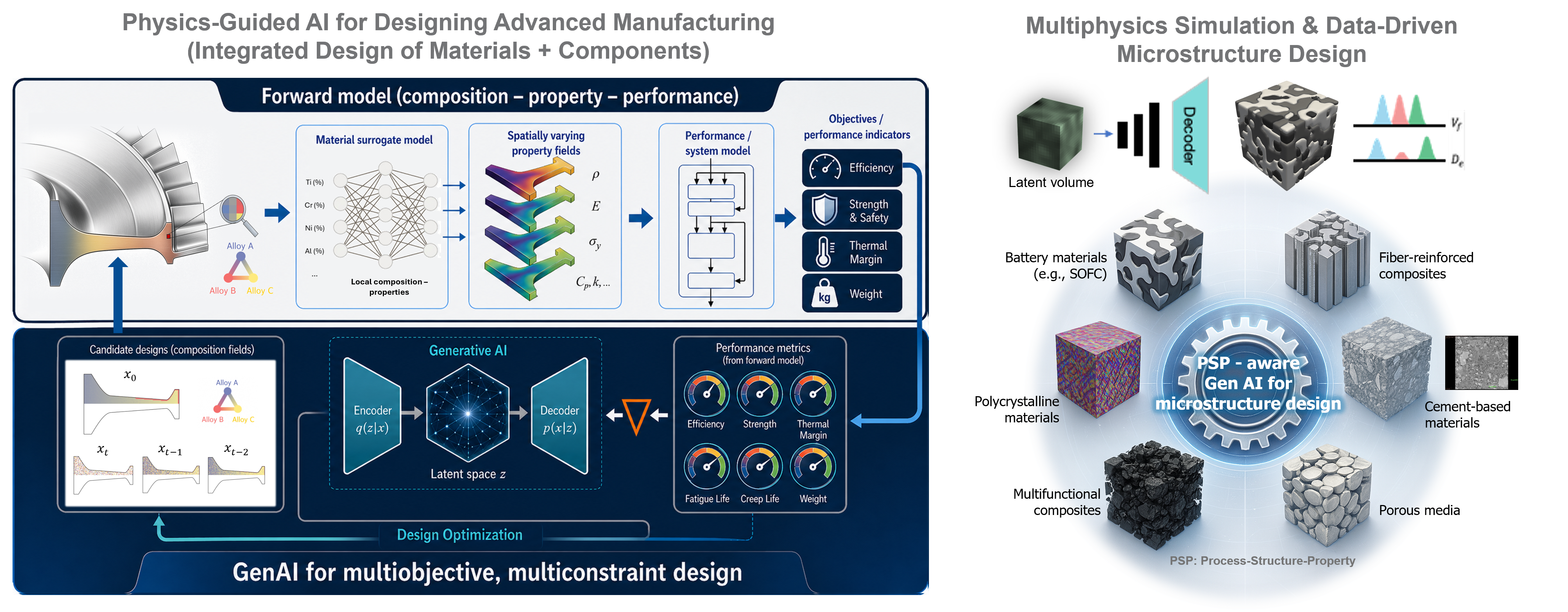
Overview. We build generative models — diffusion, autoregressive, and graph-based — that learn from physics simulations and existing designs to propose new geometries, lattice topologies, and material distributions. Unlike pure shape generation, our outputs are conditioned on engineering targets (stiffness, weight, thermal margin, finite life, manufacturability) and on process constraints.
Key topics.
- Physics-guided generative models
- Inverse design under multi-objective performance targets
- Manufacturability-aware generation
- Learned design representations (implicit fields, graphs, voxels)
Multiphysics & Multiscale Modeling
Physics-based simulation (FEM, FVM) that bridges scales — from microstructure evolution and process physics to component-level mechanical and thermal performance.
소재 물성을 예측하기 위해 다양한 물리 현상과 길이 스케일을 통합적으로 해석합니다. FEM, FVM 등 물리 기반 시뮬레이션을 활용해 공정 중 발생하는 물리 현상, 미세구조 변화, 최종 소재 물성을 연결하고, 공정-구조-물성(Process-Structure-Property) 관계를 구축합니다.
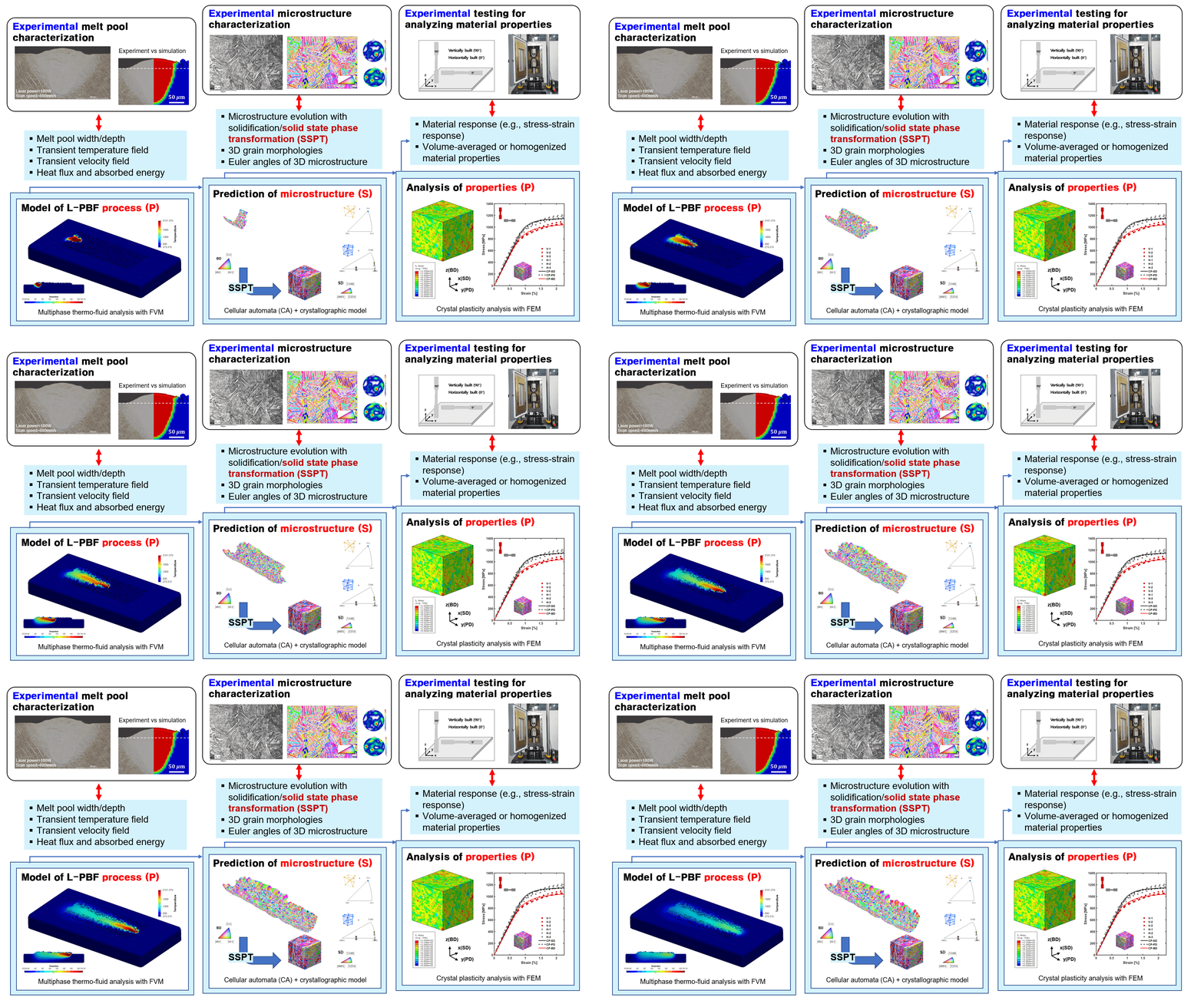
Overview. We develop and use multiphysics simulations — thermal, mechanical, microstructural — for materials and manufacturing processes, with an emphasis on metal additive manufacturing. We are especially interested in surrogate-model-friendly simulations, structured so that machine learning can absorb their behavior and reuse it during design.
Key topics.
- Process-Structure-Property (PSP) linkages
- Multiscale simulation linking microstructure to component performance
- Surrogate and reduced-order models for design-time use
- Uncertainty quantification across scales
Sparse-to-Rich 2D/3D Material Characterization & Reconstruction
Data-efficient prediction of 3D microstructures, properties, and performance from limited 2D observations — expanding local surface data into representative 3D volumes.
제한된 2D 이미지와 국소 관측 데이터로부터 3D 소재 미세구조, 물성, 성능을 예측합니다. 2D 표면 정보를 대표적인 3D 체적 구조로 확장하여 직접 관찰하기 어려운 내부 구조와 3D 거동을 추론합니다.
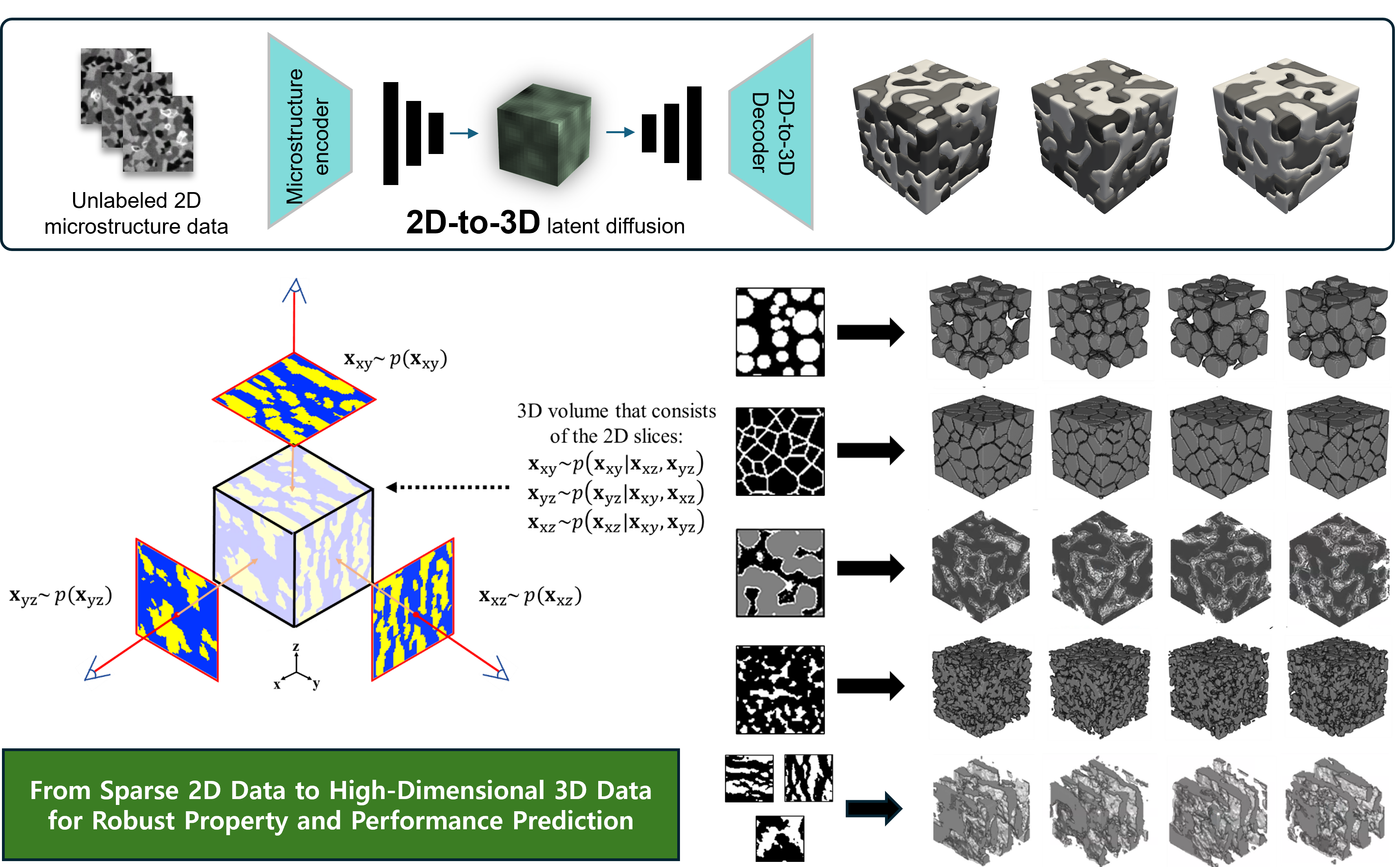
Overview. This thrust aims to enable data-efficient prediction of 3D material structures, properties, and performance from limited 2D observations. By expanding local 2D surface information into representative 3D microstructures, this approach provides a pathway to infer internal structures that are difficult to directly observe. The reconstructed 3D data will be validated using paired 2D/3D datasets and integrated with uncertainty quantification and physics-guided analysis for robust materials prediction.
Key topics.
- 2D-to-3D dimensionality expansion of material microstructures
- Surface-to-volume inference for internal 3D structure prediction
- Data-efficient 3D property and performance prediction from local 2D data
- Paired 2D/3D dataset construction for model training and validation
- Uncertainty quantification for reliable 2D-to-3D prediction
- Physics-guided validation of predicted 3D microstructures and behavior
Digital Engineering for Advanced Manufacturing
Digital twins, design automation, and end-to-end pipelines that connect CAD, simulation, and manufacturing data.
CAD, 시뮬레이션, 제조 데이터를 하나의 디지털 흐름으로 연결합니다. 디지털 트윈, 설계 자동화, end-to-end 데이터 파이프라인을 통해 첨단 제조 공정과 부품 설계의 효율성과 신뢰성을 높입니다.
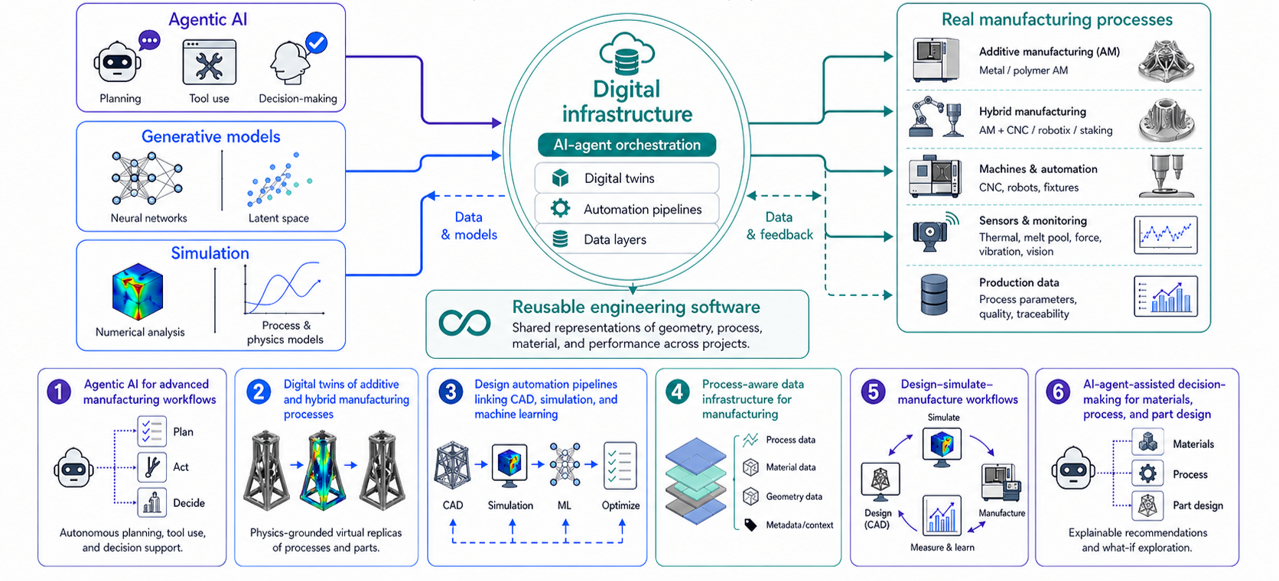
Overview. We build agentic AI and digital infrastructure — digital twins, design automation pipelines, and process-aware data layers — that enables generative models, simulations, and manufacturing processes to interact within closed-loop engineering workflows. The aim is reusable engineering software, not one-off scripts: shared representations of geometry, process, material, and performance that can evolve across projects.
Key topics.
- Agentic AI for advanced manufacturing workflows
- Digital twins of additive and hybrid manufacturing processes
- Design automation pipelines linking CAD, simulation, and machine learning
- Process-aware data infrastructure for manufacturing
- Design–simulate–manufacture workflows
- AI-agent-assisted decision-making for materials, process, and part design